



How to choose a durable backpack battery?
What is a backpack battery?
In the modern world of power tools, backpack batteries are playing an increasingly important role. Thanks to their running time and their mobility, they make it easier to carry out many gardening and maintenance tasks by enabling tools to be powered without the need for cables. a21> and maintenance tasks by enabling tools to be powered without being restricted by a cable. It is therefore essential to choose a model suitable for your needs.
Read the buying guide for backpack batteries written by a team of experts in sustainability.
For LONGTIME® experts, choosing a backpack battery is not simply a matter of comparing performance. It is also important to consider the product’s durability, reparability and suitability for its intended use.
We will look at in detail the operation of these batteries, the various technologies available and their main components. We will also present the purchase criteria to take into account, the best maintenance practices to extend their service life as well as certain routine maintenance tasks such as ... a26> certain routine maintenance tasks.
Let us guide you through the key points you need to know in order to choose a backpack suitable for your needs and uses.
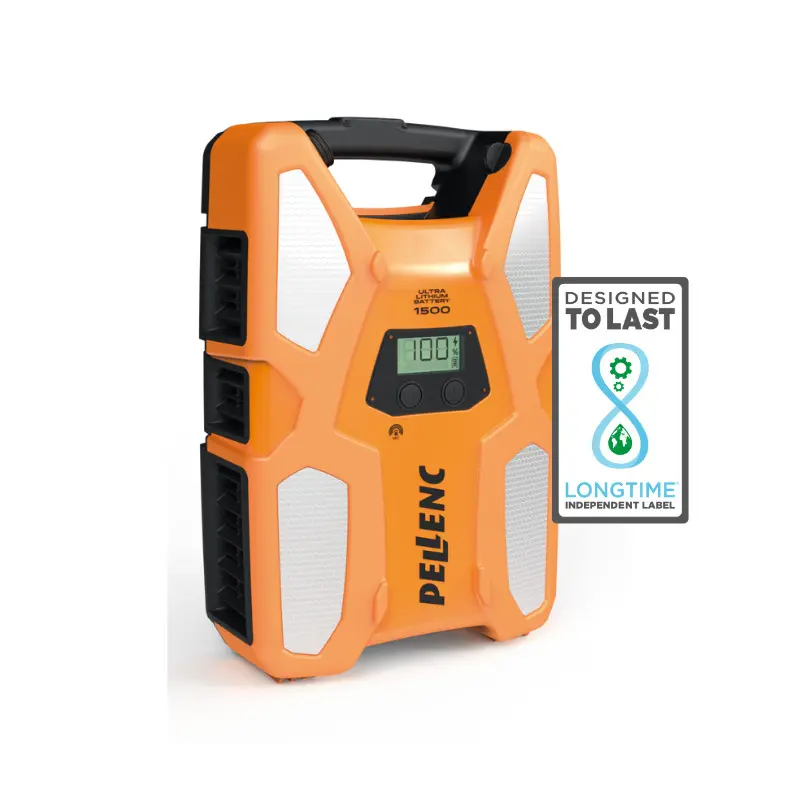
The more you know about backpack batteries, the better, the better. In the rest of this article, we will therefore go into more detail about the technical aspects. If this information seems too complex to you and you would like simply to identify products that meet certain requirements a21> identify some products that meet certain requirements for sustainability, in terms of reliability and in terms of repairability, you can rely on the LONGTIME® label.
The batteries have received LONGTIME® after having been assessed according to 38 criteria covering in particular the repairability and reliability by an organisation acting as an independent audit body.
What is a backpack battery?
A backpack power pack is a portable, self-contained power source which is worn on the back by means of a harness or an system for ergonomic attachment. It supplies the power required for the operation of power tools such as hedge trimmers, chainsaws, chainsaws, such as brush cutters, such as leaf blowers and many other pieces of equipment.
The different types of batteries for garden tools :
To characterise a battery, it is particularly useful to consider the technology of the battery used. Today, lithium-ion batteries are the most common, but this has not always been the case.
Lithium-ion (Li-ion) battery
Lithium-ion batteries are widely used because of their energy density is high and because their weight is relatively low. They work by means of the movement of lithium ions between the positive and negative electrodes during the charge and discharge cycles.
What are the advantages of a reliable lithium back-up battery?
Lithium-ion batteries are valued for their light weight, energy storage capacity and low self-discharge rate. They therefore retain their charge relatively well when not in use for extended periods, which can be particularly beneficial for gardening tools that are subject to seasonal storage.
They are also not very susceptible to the memory effect, unlike some older technologies. Their cost may however be higher than that that of older battery technologies.
Backpack modern batteries very largely use lithium-ion technology, particularly suitable for applications requiring a high energy capacity, a good range and a weight that is kept under control.
Nickel-cadmium (Ni-Cd) battery
Nickel-cadmium batteries were commonly used before the widespread adoption of lithium-ion technologies. They were gradually been replaced mainly due to their greater weight, due to their susceptibility to the memory effect and the constraints environmental associated with the use of cadmium.
Nickel-metal hydride (Ni-MH) battery
Nickel-metal hydride batteries are an alternative to nickel-cadmium batteries. They offer a capacity energy greater than that of comparable Ni-Cd technologies and are less susceptible to the memory effect. They remain however generally heavier and exhibit a self-discharge rate that is higher than that of modern lithium-ion batteries.
History of batteries
The first mobile power solutions for power tools were relatively heavy and bulky, which limited their battery life and ease of use. Backpack batteries have gradually been developed to meet the needs of activities requiring a mobile power source with a higher capacity.
The first generations of portable systems were able to use older technologies, notably lead-based ones, the main drawback of which was their heavy weight.
Nickel-cadmium (Ni-Cd) and, subsequently, nickel-metal hydride (Ni-MH) technologies then made it possible to gradually reduce weight and improve performance. The widespread adoption of lithium-ion batteries marked a new milestone, thanks to their higher energy density and a more favourable weight-to-range ratio. These advances have spurred the development of backpack batteries in sectors such as grounds maintenance and certain professional trades.
How do batteries for hand-held power tools work?
Discover the basics of this rechargeable power source and understand the crucial role it plays in tool efficiency. Whether you're a professional or a do-it-yourselfer, this understanding is essential to optimizing the use of your equipment.
Quel est le rôle des principaux composants ?
In a battery, each component plays an essential role in ensuring proper operation:
BMS ou « Battery Management System »
The BMS is the system for managing the battery. It is an electronic device, usually built into the battery, which monitors its condition and helps to ensure its safe operation. To put it simply, it is, in a way, the “brain” of the battery.
Loaders
Chargers enable you to recharge the battery when it is discharged. Their design can in particular influence the speed of charging, energy efficiency and thermal management during charging.
Battery cells
Each cell acts as an energy storage unit. Cells are usually assembled to increase the battery’s total capacity and voltage. They are organised into an assembly linked by mechanical and electrical connections suited to the battery’s design, for example by means of soldering, springs or other connection systems.
Handle
A backpack battery can be quite heavy, which is why it is advisable to carry it using a suitable harness. It also contains sensitive electronic components that may be damaged in the event of an impact or a fall, despite being housed in a protective casing.
The handle is therefore an important component. It must be ergonomic and robust, and allow the battery to be handled easily whilst minimising the risk of it falling or being knocked during transport and installation.
HMI or ‘Human-Machine Interface’
A human-machine interface (HMI) is a system or device that enables communication and interaction between the user and the machine. On a backpack battery, it usually takes the form of a small, ruggedised screen, possibly accompanied by control buttons, which displays simple information about the battery’s status, such as its charge level.
How to choose a reliable backpack battery?
Find out the key criteria for choosing a backpack battery that suits your needs. This section outlines the main factors to consider when assessing the reliability and durability of your power source.
Beyond immediate performance, it is important to consider factors relating to durability. The design of the cells, the quality of the electronic components, thermal management and the robustness of the casing can all have a significant impact on the battery’s lifespan.
Battery cell matrix reliability
The system for connecting between the cells plays an important role in the reliability of the whole system. It must be suited to the dimensions of the battery and withstand the mechanical stresses encountered during use, in particular vibrations and micro-shocks. Depending on the design of the pack, various systems for connection may be used between the cells, such as welds, such as springs or other devices for mechanical and electrical connection.
Cell balancing is also a key consideration. In many battery packs, the failure of a single cell can significantly affect the performance of the whole pack and require work to be carried out on the entire pack. The quality of the cells, their assembly and their electronic management therefore play a decisive role in the battery’s longevity. However, technologies are evolving rapidly and may, in the long term, further improve the reparability of backpack battery packs.
Reliability of electronic components
The reliability of the internal electronic components is essential to the battery’s service life. They must be correctly rated and capable of withstanding the stresses associated with prolonged use, including temperature fluctuations, vibrations and repeated electrical stresses.
When choosing a battery, opt for those manufacturers who are able to provide clear information on the design, reliability and availability of components or spare parts for replacement.
Efficient management by BMS electronic board
Le BMS joue un rôle central dans le fonctionnement de la batterie. Il surveille et régule différents paramètres afin de protéger les cellules et d’assurer une utilisation maîtrisée de l’énergie. Un système de gestion performant peut notamment suivre la tension, le courant, la température des cellules, la capacité restante et le nombre de cycles de charge.
The BMS must also help to protect the cells from conditions that could accelerate their degradation, such as overcharging, overheating or deep discharge. The quality of this electronic management is therefore a key factor in maintaining the battery’s performance over time, particularly during prolonged periods of storage.
Robustness and durability of materials
The materials used for the housing and the various components play a major role in the durability of the battery. They must be capable of withstanding impacts, moisture and changes in temperature compatible with the intended conditions of use.
Une conception robuste permet de mieux protéger les cellules et les composants électroniques contre les contraintes rencontrées lors du transport et de l’utilisation en extérieur.
Cooling system
Effective thermal management helps to maintain the battery’s performance and service life. The cells and electronic components generate heat whilst in operation and during charging. This heat must be properly dissipated in order to limit prolonged exposure to high temperatures.
The design must therefore strike a balance between thermal dissipation and protection against external external aggressive factors. The openings or devices designed to dissipate heat must not not compromise unnecessarily protection against dust, moisture or splashes. The choice of materials for the housing and its design can also help to facilitate thermal dissipation whilst maintaining an level of robustness that is appropriate.
```

Quality-price ratio of back batteries:
When it comes to making your choice, don’t just settle for the product that’s the cheapest. Look for instead a good value -price, taking into account the quality of manufacture, the performance, the durability and the overall cost of the product.
Compare the technical specifications, the warranties, the availability of spare parts and the terms of after-sales service in order to help you identify the model that is best suited to your needs. Please also feel free to check the availability and the prices from a number of retailers.
Battery performance criteria :
These criteria play an important role in the performance, battery life and user satisfaction. This section presents the main features to take into account when choosing a backpack battery backpack suitable for the needs of your power tools .
Battery capacity, voltage and power
Capacity
The capacity for storing energy directly affects the range of the battery. It is generally expressed in ampere-hours (Ah) and, to compare more precisely batteries with different voltages, in watt-hours (Wh). A capacity that is higher generally allows the battery to run for longer before having to recharge the battery. It is therefore important to choose a capacity suitable for the duration and intensity of your usage.
Voltage
Check that the battery voltage is compatible with that required by your tools. An incorrect voltage may prevent them from working, impair their performance or, depending on the system design, pose a risk to the equipment. Always use a battery and adaptors that are explicitly compatible with the manufacturer’s recommendations.
Power
The battery must be capable of supplying the power required for operation of the tool, particularly during periods of heavy use. This capacity depends in particular on its voltage, the current it can supply and the limits defined by its electronic control system.
A battery correctly sized enables the tool to operate under the conditions specified by the manufacturer and limits the excessive strain on the battery. It is therefore preferable to check the compatibility between the battery, the tool and the system for management rather than simply searching for a34> simply the battery offering the power or the capacity that is highest.
Energy efficiency is also something to take into account. A battery suitable for the intended use enables us to find a good balance between battery life, weight, charging time and performance.
Autonomy and charging time
The running time of a power tool depends directly on the energy available in its battery and on the power consumed whilst it is in use. One of the main advantages of backpacks is their energy capacity, which is generally greater than that of small batteries directly attached to the tools. Their capacity allows for more of cells to be incorporated whilst transferring a significant portion of the weight onto the user’s back.
The actual battery life depends however on many factors: capacity of the battery, power of the tool, level of use, temperature, condition of the battery or even usage scenario. To compare two models, it is therefore preferable to base oneself on a scenario that is comparable and representative of your business.
Charging time
The time taken to recharge can have a significant impact on the organisation of work. It depends in particular on the capacity of the battery, on the power of the charger, the temperature and the limits on charging defined by the BMS. For a professional intensive use, compare therefore both the range and the time required to regain asufficient charge.
Quick-change system
A system enabling the replacement of a battery that is flat with a battery that is fully charged can minimise the interruptions to work. This feature is particularly useful for those professional uses requiring long periods of use.
Fast charging
Fast charging allows you to reduce the time required to recharge a compatible battery. It requires however a charger and a battery specifically designed to handle this charging power. Appropriate thermal and electronic management is therefore particularly important for maintaining the safety and service life of the cells.
Compatibility with various tools
The ability to use a single single battery with several tools can improve the versatility of the system and reduce the number of batteries required. Check however carefully the compatibility specified by the manufacturer, in particular regarding voltage, the connectors, the adapters and any communication protocols between the battery and the tool.
Maximum discharge current
The maximum discharge current refers to the battery’s ability to supply a high current, either briefly or continuously, when the tool requires it. This parameter may be important for equipment that experiences high power peaks at start-up or during certain stages of operation. It must be suited to the tool’s specifications and remain within the limits specified by the battery manufacturer.
Additional features and options
In addition to their own fundamental features, thebackpacks can incorporate various features designed to improve safety, the comfort of use and the monitoring of their operation.
Overcurrent protection
Protection against overcurrent allows for the current to be limited when it exceeds the current limit when it exceeds the current limit when it exceeds the current limit when it exceeds the current limit when it exceeds the current limit when current when it exceeds the values specified by the system. Generally provided by the BMS, this function helps to protect the cells, the electronics and the equipment connected against certain abnormal situations.
Indicator of level of charge
A indicator of battery charge enables you to estimate the remaining power and to better organise the periods of use and recharging. Some systems also provide an estimate of the remaining range or additional information on the state of the battery or other parameters. a21> some additional information on the condition of the battery.
Bluetooth connectivity
Some models feature Bluetooth connectivity allowing you to view information information from a smartphone or a tablet. According to the manufacturer, the app can in particular display the battery charge level, certain usage data, some diagnostic information or some operating parameters.
Accessory pack
Some models are available with some accessories designed to improve the comfort, the transport or the compatibility with various equipment. This may include, for example, a harness, cables, such as mounts, such as systems for securing or adaptors enabling the battery to be used with several tools from the same range.
How can you make your backpack battery last as long as possible?
A reliable backpack battery is a significant investment. To get the most out of it, it is essential to use and maintain it correctly in order to preserve its performance and lifespan. Here are some best practices to bear in mind.
How to use a backpack battery
The use of a backpack battery is not limited to connecting or disconnecting it the tool. Good practices for its use help to improve its efficiency whilst limiting the strain that is likely to accelerate its ageing.
Tips for using a backpack battery
As with any equipment, it is essential to follow the manufacturer is essential to preserve the lifespan of the battery. Take the time to read the manual and the instructions specific to your model.
Initial load
Before first use, follow the manufacturer’s instructions regarding the initial charge. Modern lithium-ion batteries do not necessarily always require a full charge before their first use, but it is important to follow the recommendations specific to the product.
Appropriate use
Use the battery only with compatible tools and equipment. Check in particular the voltage, the connectors and any possible communication requirements between the battery and the tool.
Management of the load
Avoid repeated deep discharges as far as possible. Recharge the battery when its charge level becomes low, in accordance with the manufacturer’s recommendations. Modern systems generally feature a BMS that protects the cells against overcharging and excessive discharging, but good charging practices nevertheless help to preserve their service life.
When recharging, please also ensure you stay within the temperature range recommended by the manufacturer. Temperatures that are too high or too low can reduce charging performance and accelerate cell ageing.
Storage suitable
When not in use, store the battery in a place that is dry and protected from damp, from extreme heat, from frost and from direct sunlight from the sun. For periods of extended storage, follow the recommendations from the manufacturer regarding storage. a22> recommendations from the manufacturer regarding the level of charge to be maintained.
Monitoring of autonomy
Keep an eye on changes in battery life over time as time goes on. A gradual decrease is normal as the battery ages, but a significant drop or sudden may indicate a deterioration of the cells, a problem with functioning or inappropriate conditions of use .
Safety
Always follow the safety instructions provided by the manufacturer. Avoid any falls, any severe impacts and exposure to water when the product is not designed to withstand it, as well as any use of a battery that shows any deformation, a crack, an overheating that is unusual or any other sign of deterioration.
Servicing and maintenance
As well as the right conditions of use, regular maintenance helps to ensure the continued proper operation of the battery and to quickly identify any signs of wear or deterioration.
Regular cleaning
Clean regularly the outside of the battery to remove dust, dirt and any other debris. Use a soft and dry cloth, or follow the recommendations from the manufacturer if a more thorough clean is required. Avoid getting any liquids into the connectors or the openings of the housing.
Occasional calibration
Some manufacturers may recommend a procedure for calibration in order to improve the accuracy of the charge indicator or the battery management system. This operation must only be carried out when when it is specified in the product’s documentation.
Cable inspection
Check regularly the power and connection cables. Look out for in particular any breaks, crushed sections, cracks, connectors that are damaged or signs of overheating. A cable that is damaged must be replaced with a part before any further use.
Visual inspection
Carry out regular a visual inspection of the battery and of its housing. Check for any cracks, any deformations, of swelling, of signs of impact or other abnormalities. If any unusual defect is detected, stop using the battery and consult the recommendations from the manufacturer or a qualified technical service.
How to repair your back battery?
Back may sometimes exhibit some malfunctions requiring a diagnosis or a repair. However, due to the energy stored in the lithium-ion cells and the presence of electronic components, internal repairs must be carried out only by qualified qualified professionals only.
Troubleshooting and solutions to common problems
Before any work is carried out, consult the instructions from the manufacturer and follow the safety guidelines relating to your battery. Do not open the housing or tamper with the cells, the BMS or the internal connections. If you are in doubt, contact the manufacturer, your dealer or a qualified repairer.
The checks described below relate solely to checks external that do not require the removal of the battery.
What should I do if my battery doesn’t charge?
If the battery does not charge any more or if the tool does not work any more when it is connected, follow these steps:
- Check that the electrical socket is working by plugging another device into it.
- Make sure that the charger you are using is indeed compatible with the battery and check any any indicator lights or error messages.
- Inspect visually the connectors on the charger and on the battery in order to to identify any signs of dirt, or deformation, or corrosion or or damage.
- Check the battery charge indicator when the battery has one and refer to the user manual to interpret any potential error codes.
- If you have another battery or charger that is fully compatible, a cross-test may help to determine whether the problem lies with the battery, the charger or the tool.
- If the battery remains inoperative, contact the after-sales service or a qualified professional to carry out a diagnosis.
Do not carry out any electrical measurements directly on the cells or the internal terminals of a lithium-ion battery, unless you are authorised and have the appropriate < a19> procedures and equipment suitable for the task.
My battery overheats
An temperature that is abnormally high may indicate a malfunction in the battery, of the charger or of the tool. A battery that overheats excessively must be taken seriously.
- Stop immediately using the tool and disconnect the battery from the tool if this can be done without risk.
- Do not recharge the battery until the cause of the overheating has been identified.
- Leave it to cool in a well-ventilated area, away from flammable materials and sources of heat.
- Check only from the outside externally that the ventilation openings, where they exist, are not blocked.
- In the event of swelling, of deformation, an unusual odour, smoke or a leak, stop all use and follow the safety instructions from the manufacturer.
- If the overheating problem occurs again, contact the retailer, the manufacturer or a qualified repairer.
The battery no longer holds its charge
A reduction in battery life may be attributed to ageing of the cells, to conditions of use, to temperature, the charger or a malfunction of the battery.
- Check that the charger you are using is compatible and works as normal.
- Make sure that the battery has been given the charging time recommended by the manufacturer.
- Compare battery life under similar conditions of use to determine whether the reduction is actually significant.
- Check that the battery is not in use or stored at temperatures temperatures that fall outside the recommended ranges.
- If the loss of range becomes significant or sudden, have the battery checked by a professional in order to determine whether the cells, the BMS or any other component is at fault.
The battery is making some unusual noises
An unusual noise coming from a backpack battery may in particular be related to its ventilation system or indicate a malfunction requiring an inspection.
- Stop using the tool and disconnect the battery from the tool.
- Inspect visually the housing to check for any signs of impact, deformation, and any damage caused by impact, deformation, and any signs of impact, deformation, and any damage caused by impact, deformation, and any signs of impact, deformation, and any damage caused a8> signs of impact, of deformation or of overheating.
- If the battery has a ventilation system, check externally that the vents are not blocked.
- If the noise persists or appears to be coming from inside the battery, do not attempt to open it or to repair it yourself. Contact the manufacturer, the after-sales service or a qualified professional.
Summary of key points to consider when purchasing a backpack battery
Battery types: There are several types of battery for hand-held power tools, including lithium-ion, nickel-cadmium and nickel-metal hydride batteries. Lithium-ion batteries are the most popular for their light weight and high storage capacity.
Backbone battery components: A backbone battery comprises several important components, including the battery cell matrix, the Battery Management System (BMS) electronic board, the HMI (display)...
Entretien et maintenance : Pour prolonger la durée de vie de votre batterie dorsale, il est recommandé de suivre des pratiques d’entretien : During the life of the battery: charge in a place with the right temperature and humidity, avoid overcharging the battery by leaving the charger connected for long periods, avoid deep discharging (leaving the battery discharged for a long time), follow proper use. Ensure proper storage in a dry place at room temperature. Regularly check the autonomy of your battery to detect any potential problems and, lastly, follow the safety instructions.
Criteria for selecting a durable back-up battery: it is essential to take into account criteria such as component reliability, effective management of operation by the BMS electronic board, robustness of case materials, reliability of the cell matrix and optimisation of the balance between cooling system and sealing. Performance criteria are also important for making the right choice: capacity, voltage, power, autonomy, charging time, compatibility with different tools.
Battery repair and fault resolution: common faults with a back-up battery are overheating or failure to charge. In the event of a problem, please follow the manufacturer's instructions and take appropriate safety precautions. Don't take any chances, just check simple things like whether the battery charger plug works. Try plugging in another electrical product, such as a lamp or phone charger, and check that they are powered by the same socket. Check that ventilation openings are unobstructed. In the event of a persistent problem, we recommend that you consult the manufacturer's customer service department or a repair professional.
To go further with LONGTIME®
Would you like to buy a durable, reliable back-up battery tailored to your needs without a degree in civil engineering and without poring over 15 blogs and 4 consumer magazines?
Have a look at our product catalogue, you will find just what you’re looking for!