


Whether you want to try new recipes, perfectly cook meat, king prawns, cuttlefish, sardines or vegetables such as courgettes, aubergines and peppers, or simply enjoy a meal outdoors with friends, a griddle helps preserve the flavours and nutritional qualities of your food. However, with so many different types and models available, choosing the right one isn’t always easy.
That whets your appetite, doesn't it? So are we, but this article won't give you any recipes for cooking à la plancha - we're sure you're already doing just fine - our aim is to:
- Clarify how planchas work and identify their differences to help you make a choice suited to your needs and expectations,
- Help you understand the markers of durability, reliability and repairability of planchas, so you can enjoy your appliance for a long time to come,
- Give you maintenance and repair advice.
Read the coffee machine buying guide written by sustainability experts
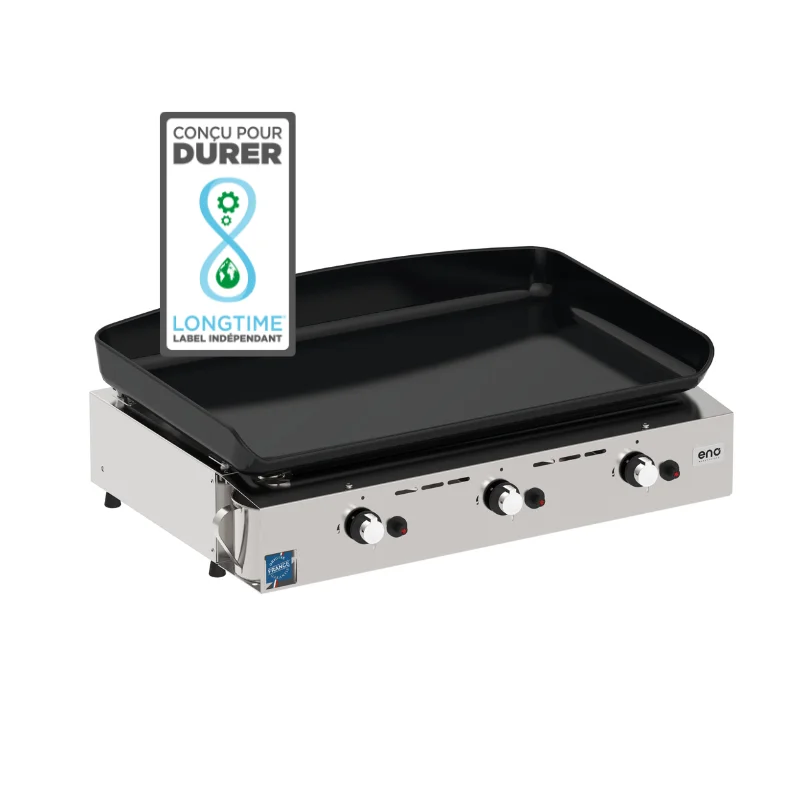
Because we believe knowledge is power, we get into a few technical details. If the rest of this article seems a little complex, simply put your trust in the LONGTIME® label. A range of plancha grills recently earned the label following an independent assessment against our 38 durability criteria.
How does a plancha work?
If you enjoy sharing meals outdoors and cooking food while preserving its nutrients and flavours, a plancha griddle is an excellent choice. Unlike a barbecue, it cooks food without direct contact with a flame. But what exactly is a griddle? Whatever the type, whether mounted on a trolley or not, the aim is the same: to cook food outdoors with precise temperature control, even heat distribution and rapid heating.
There are two main categories of plancha:
- Gas griddle
A gas griddle works as follows: a pipe carries the gas to the components under the griddle, called burners. These burners are pipes, most of them made of stainless steel, with small holes at regular intervals to allow the gas to escape. An ignition button uses a battery to activate an electric piezo which generates a spark and allows the gas to ignite. The resulting flames heat the underside of the hob to provide a rapid, even temperature rise.
- Electric griddle
The operating principle of an electric griddle is equally simple: a control knob connected to an electronic board controls the power supply to a heating element via a thermostat. This resistor heats the underside of the hob to provide a rapid, even temperature rise.
How to check the reliability and sturdiness of a plancha?
You've chosen the technology that best suits your needs; perfect. But what model of plancha should you choose? To ensure you make a safe and trustworthy purchase, there are certain features and points we recommend you pay attention to; deciphering.
How to check the reliability and reparability of a gas or electric griddle?
The reliability of plancha plates:
Whether the griddle of your plancha is made of steel, stainless steel, chrome or enamelled cast iron, here are 3 important points concerning the reliability of this component:
- Plate material: Particular attention must be paid to the physico-chemical quality of each material and to the dimensions of the plate (thickness in particular). The original quality of the material, coupled with a sufficient thickness/size ratio, is a guarantee of quality. Bear in mind that the larger the griddle, the greater its thickness. This will avoid any risk of deformation of the plate.
- Enamelling of cooking plates: Griddles with enamelled cooking plates (cast iron or steel) must have excellent mechanical stability. The plates must not warp, as deformation can cause the enamel to chip.
The enamelling process itself requires meticulous workmanship. Where possible, choose manufacturers with proven expertise and opt for a plate with multiple layers of enamel for greater durability. - Cooking plate welds: (process quality, welder qualification certificate)
If the cooking plate has any welds, they must be made in strict accordance with best welding practices. For stainless steel plates, argon-shielded welding helps preserve the plate’s corrosion resistance.
Reliability of the electric resistance (electric plancha) :
Electric resistors are sensitive to humidity due to their construction.
For outdoor use, an electric griddle must be designed to withstand outdoor conditions. Resistive heating elements generally use nichrome wire (80% nickel, 20% chromium), ribbon or strip. This relatively high-resistance material forms an adherent layer of chromium oxide when first heated.
The resistance wire is generally wound into a coil, surrounded by densely compacted magnesium oxide powder, and enclosed in a protective sheath.
This material offers excellent thermal conductivity and high dielectric strength. Ceramic or mica insulators electrically isolate the terminal pin from the sheath.
Ideally, your griddle’s heating element should have a stainless steel sheath or be of the sheathed type. In all cases, make sure the heating element is adequately protected against splashing water (IPX4 rating).
Burner reliability (gas plancha) :
Plancha burners have a major impact on the lifespan of your appliance. For outdoor use, burners must be highly corrosion-resistant (stainless steel, galvanized steel, aluminized steel, enamelled cast iron).
The provenance of the burners—including the manufacturer’s certifications and reputation, as well as technical data on wear and ageing—is also important when choosing a griddle.
Although this information can be difficult to obtain, don’t hesitate to ask to have the cooking plate removed in-store so you can inspect the quality of the burners. Assess their apparent quality and how securely they are mounted, and ask the sales staff questions.
The expert's word: We'll say it one more time, but burners and plates are elements on which you can't afford to compromise on quality.
Reliable chassis for long-lasting plancha :
The chassis is also subject to the stresses of use (splashes, heat, sharp utensils, etc.) and the environment (UV radiation, humidity, etc.). It must therefore offer enhanced resistance to these stresses, particularly at the weld level (a sensitive point for corrosion attack): marine-grade argon welding is preferred.
And don't hesitate to ask about finishing and corrosion protection processes, including galvanizing, electro-galvanizing, cataphoresis and powder coating.
What type of plancha should you choose to suit your needs?
Gas griddles, electric griddles, enamelled cast-iron griddles, stainless steel griddles: What are the differences between electric and gas griddles, and how do you choose the right one?
A number of factors can influence your choice. To find the plancha that's right for you, it's a good idea to consider a number of factors, and to take stock of your needs and constraints.
What kind of energy should I use for my plancha?
- Gas griddle: butane or propane gas bottle according to instructions, pressure reducer, gas connection or hose.
- Electric plancha: mains connection, power cord with plug.
In some regions or local areas with a high wildfire risk, gas griddles may be restricted or prohibited. Apartment building rules may also prohibit the use of gas appliances, so check the applicable rules before use.
How to choose a plancha according to where it will be used?
- Gas griddle: Perfect for outdoor use
- Electric griddle: Suitable for both indoor and outdoor use for models designed for this purpose.
For use on the beach (salty environment) or in the mountains (damp environment), the choice of materials will be of paramount importance, and you'll need to select materials that are highly resistant to corrosion.
Taking space requirements into account when choosing a plancha :
- Gas plancha: heavier and generally larger planchas, an imposing appliance that can nevertheless be moved anywhere.
- Electric griddle: compact appliance, table-top for most models
Cooking surface and number of burners on planchas :
- Gas plancha: wide choice of set-ups, cooking plates up to 90 cm. 2 or more burners with independent settings. Several different foods can be cooked simultaneously on the griddle at different temperatures.
- Electric plancha: a wide range of sizes on the market, up to around 70cm. Even temperature distribution.
It's not easy to size the appliance correctly, but keep in mind that the larger your plancha, the more energy it consumes. Sizing is therefore based on your needs and the size of your family.
The speed and heating power of planchas
- Gas griddle: unquestionably more efficient in terms of temperature rise (twice as fast as electric on average). Higher power to perfectly capture and obtain the Maillard reaction
- Electric griddles: some models feature 2 heating elements to optimize cooking and deliver maximum power.
The cost of buying a plancha :
- Gas griddle: Generally more expensive than an electric griddle of the same size and power.
- Electric griddle: generally less expensive than a gas griddle of the same size and power.
How much to invest in a plancha :
Griddles are available at every price point, and, as is often the case, quality varies widely. As a general rule, remember that you get what you pay for: beware of false bargains and no-name brands whose products may quickly end up at a waste disposal centre.
The price of a griddle depends on the quality of its components—the cooking plate, chassis, burners, electronic circuit board and heating element—as well as its design, the quality of its materials and where it is manufactured.
Our advice if you're on a tight budget, choose a smaller plancha and forget the cart. Focus on the essentials, plate, burner.
How to make your plancha last as long as possible?
Two factors will determine how long your griddle will last: the quality of its main components (griddle, burners, thermostat) and maintenance (cleaning, storage).
Bear in mind that planchas are very sensitive to maintenance, use (utensils used, etc.) and storage (sheltered from environmental constraints, protected from insects, etc.). Even with the most robust and reliable plancha in the world, if you don't carry out any maintenance, the lifespan will be considerably reduced.
Read the instructions for use and maintenance of your plancha.
Planchas require simple but frequent periodic attention.
Gas plancha maintenance - when to clean your plancha?
- Cleaning burners after wintering (gas griddle)
- Clean the plate after each use according to the manufacturer's recommendations.
- Wipe grease and juice splashes from the griddle frame and around the product.
- Two accessories will make your plancha last: the hood and the plancha cover. Priority is given to the hood, but if you can afford it, don't hesitate to invest in a cover to protect your plancha between uses.
- In winter, when you're not using your plancha, protect it from humidity and treat it against corrosion if necessary.
Expert advice: While the plancha is indeed a healthier cooking method than the barbecue from the outset, you should be aware that cooking on a dirty plancha, accumulating carbon deposits, is not necessarily ideal.
Every plate has its own cleaning method! You can't become a griller without learning a little!

How to repair your plancha?
The best breakdown is the one that doesn't happen. Have you invested in a beautiful plancha or received one as a gift? To avoid breakdowns and problems, here is a short list of basic rules to follow:
- Choosing the right broadcast technology for your needs
- Avoid (shun) entry-level products
- Check availability of spare parts (plate, burners, resistance)
- Comply with usage and, above all, maintenance instructions
If you observe these few basic rules and have chosen a durable, i.e. sturdy, reliable and repairable griddle, you should be relatively safe.
However, no brand is immune to failure, and no product is infallible.
You turn on your plancha and nothing works: Why doesn't my plancha work anymore? Why doesn't my griddle heat up? Why won't my plancha light up? Why does my griddle heat up less? Why is my griddle rusting?
If you recognize yourself in one of these questions, we'll try to help you. On a plancha, whether gas or electric, you should normally be able to access the internal components without difficulty, and there's no reason why accessibility to the main components (burner, ignition system for a gas plancha, electronic board, resistance, thermostat for an electric plancha) should be impeded.
In the event of a breakdown, check the warranties first:
- If your griddle is less than two years old, contact the distributor who sold it to you, who is contractually responsible for the legal guarantee of conformity.
- If your griddle is more than two years old, check whether you took out insurance or an extended warranty. Also check any manufacturer’s or commercial warranties, as these may provide longer coverage and continue after the statutory guarantee of conformity has expired. Warranty periods may also vary by component: some griddle cooking plates, for example, come with a lifetime warranty.
Your griddle is no longer under warranty, don't panic! There are several points to check before declaring your product out of service:
- Guarantee or not, in all cases, first contact the after-sales service of the brand of your product, either directly with the manufacturer, or via the retailer.
- For electric planchas, before undertaking any repairs, always check that the appliance is correctly powered by checking your socket. To do this, unplug your plancha from its electrical socket and plug in another appliance (bedside lamp, clock radio, telephone charger). If nothing happens, there's a good chance the problem is with your electrical network.
- If your electric griddle causes your system to trip, the electrical resistance may have absorbed too much moisture. Take your plancha inside your home and simply wait a few days, then try again. If the problem persists, it means that the problem is more serious, and that a change of resistor should be considered.
- For a gas griddle, first check that your gas cylinder is not empty and that the gas is flowing correctly from the burners. Make sure you have nozzles that are compatible with your type of gas.
- If the cylinder is full but the gas isn't coming out, there's a good chance that a small spider-like creature is blocking the distribution line. Ditto if the plancha doesn't work properly. Clean all gas-carrying piping to remove any blockages, observing all necessary gas safety precautions.
- If your gas griddle is correctly powered but refuses to light, check the condition of the ignition battery linked to the piezzo and replace it if necessary. You may find it useful to use a long-nose gas lighter.
- You have significantly altered your siding. Solutions may be possible, so contact the manufacturer to check whether it's possible to refurbish your plate.
Repair tutorial for planchas
For the more DIY-minded among you, some problems can be solved by DIY (Do It Yourself). The Internet is full of explanatory videos, and there are many groups on forums.
You’ll learn how to properly maintain and use your griddle, clear blocked burners, replace an ignition system and more. However, as with all electrical and electronic products—and especially gas appliances—make sure you have the necessary knowledge and skills to carry out repairs safely, without compromising the safety of the appliance or your home.
Finally, consider getting help with minor faults from local community repair groups, where volunteers help you repair your belongings.
When it comes to durability, make sure the manufacturer of your griddle has a high-quality after-sales service and/or technical support. All LONGTIME®-labeled products are repairable, so don't throw them away.
To sum up, when choosing a plancha :

- Choose brands with genuine technical support
- Check the availability of spare parts and their price.
- Make sure the key components are accessible. For gas griddles, these include the gas manifold, gas burners and cooking plate. For electric griddles, they include the temperature sensor, temperature control (thermostat), display, electronic circuit boards (power and display), heating element and cooking plate.
- Whatever type of plancha you choose, be sure to check the quality of the griddle, its warranty period and the associated warranty conditions.
Would you like to buy a plancha without being a professional chef and without reading 10 rigged comparisons?